

 Mélony Qin
 When ChatGPT made its big entrance in 2022, it showed everyone how powerful generative AI could be. But things have changed since then. If you still think that large language models (LLMs) represent all of generative AI, you’re mistaken, especially in 2024. Multimodal AI can now understand information from various sources like text, images, audio, and video. In this blog post, let’s uncover the truth about Multimodal AI foundation models in 2026.
Table of Contents
The era of multimodal AI
Unlike traditional models that focus on a single modality, such as texts or images. Multimodal AI analyzes and processes data from various sources, such as text, images, audio, and video, to better understand our world, tackle complex questions, and create quicker and more precise results than single-focus AI systems. This is similar to how humans perceive the world.
If you want to learn AI beyond those buzzwords, you may check out this video on our channel, which helps you understand those overwhelming concepts in a simple manner with real-life examples.
OpenAI’s next-level state-of-art AIs
You see, since 2023, ChatGPT has become not only the most popular chatbot on the planet, but it can also see, hear, and even speak. These abilities demonstrate that computers can understand things as humans do, including seeing, hearing, and reading text. This enables them to learn and interact in new ways, making them smarter and more flexible. And just last week, OpenAI unveiled their text-to-video model called Sora, showcasing incredible progress in AI capabilities.
You know, some AI products are literally playing with the notion of “text-to-video” by combining ‘text-to-speech’ and ‘talking pictures’. Most text-to-video models are still not mature and are far behind in achieving the same level of accuracy and realism as Sora!

Sora is a diffusion model capable of generating an entire video all at once, extending pictures or, in some cases, extending a generated video to a longer duration. Sora builds on past research on DALL·E and GPT models by leveraging a transformer architecture, but with incredible scaling performance according to OpenAI.
How AI makes stunning videos in seconds
You may already see lots of stunning videos like those all over your Instagram feed.
Videos generated by Sora by OpenAI are surreal and can be compared to Pixar animation. Lumiere from Google can bring your photos to life. VIDU from China lets you hang out with your doppelgänger.
Type a sentence… boom, it becomes a full-on video. That’s not sci-fi. That’s Text-to-Video AI.
But what’s behind the magic? It’s about Transformers and Diffusion models. How does it work though you ask
Transformers? They read your text like Shakespeare after a double espresso. They turn your words into a rich, structured guide for the diffusion process, helping the model match the meaning and flow of the text to the video frames it creates.
Then the diffusion model takes over. It’s a generative process that starts with random noise and gradually shapes it into structured visuals, turning that representation into vivid video content.
Together? That’s when the magic happens your words come alive in motion. It’s like saying, “Let’s write a movie… and skip straight to the premiere”
Google’s Gemini era
Google has unveiled its own multimodal AI, Google Gemini, which is available in three sizes.
The smallest, Gemini Nano, is tailored for edge devices like mobile phones, particularly for Android developers on devices such as Samsung Edge and Google Pixel 8 Pro. Next, Gemini Pro is the default version for their chatbot Bard, and boasts advanced reasoning and planning capabilities.
Google intends to introduce an even more intelligent version, dubbed “Bard Advanced,” powered by Gemini Ultra. Additionally, Gemini Advanced will replace DuetAI for Google Workspace and Google Cloud. Just right after , Google launched Gemini 1.5, introducing notable improvements. The exciting aspect is that this model achieves a quality akin to 1.0 Ultra but with less computing power.
Google says : Gemini will help companies boost productivity, developers code faster, and organizations to protect themselves from cyber attacks, along with countless other benefits.
This marks a new era — google’s Gemini era.
Just imagine the possibilities when Gemini is integrated into the Google Search Experience. Having tested the new search interface recently, I found it remarkably cool. I particularly enjoyed the conversational style of the results when answering search queries. This functionality could be even more effective when applied to searching and shopping for items on various e-commerce websites.
Apple Ferret is catching up
Now, you might be curious about Apple’s involvement with GenAI. Since announcing a $1 billion annual investment to catch up with the GenAI boom in 2023, Apple has collaborated with researchers from Columbia University to develop a multimodal AI named Ferret. This new AI, akin to a refined version of ChatGPT from 2022, will likely integrate computer vision capabilities by 2024.
Ferret demonstrates an understanding of connections between objects, actions, and contextual details, resembling an early version. However, it’s too soon to determine if Ferret surpasses GPT4 or Gemini.
Claude 3 Family
As the world focuses on OpenAI’s and Google’s Gemini’s supremacy in multimodal AI, Antophic quietly introduces the Claude 3 model family, an impressive addition to this landscape. Comprising three cutting-edge models—Claude 3 Haiku, Claude 3 Sonnet, and Claude 3 Opus—each surpasses expectations with escalating capabilities.

From advanced reasoning and vision analysis to code generation and multilingual processing, Claude undertakes complex cognitive tasks, transcending mere pattern recognition. Notably, with a 200K context window compared to Gemini 1.5’s 1M token context window, Claude exhibits robust contextual understanding.
In addition, Claude reportedly stands out for its exceptional security measures, trustworthiness, and with lower hallucination rates, setting it apart as a reliable and effective AI solution.
Why does a long context window matter?
Context windows allow AI models to retain lots of information while they work by utilizing extensive context during their computations. It’s like when you forget somebody’s name during a conversation or rush to write down a phone number you just heard.
With an extensive text window, the range of input possibilities spans from a basic prompt with a structured sentence of a few words to more complex inputs. For instance, it can accommodate inputs like a 400-page PDF document, a 44-minute movie file, or even 100K lines of code. Additionally, the output generated by those models is remarkably impressive.
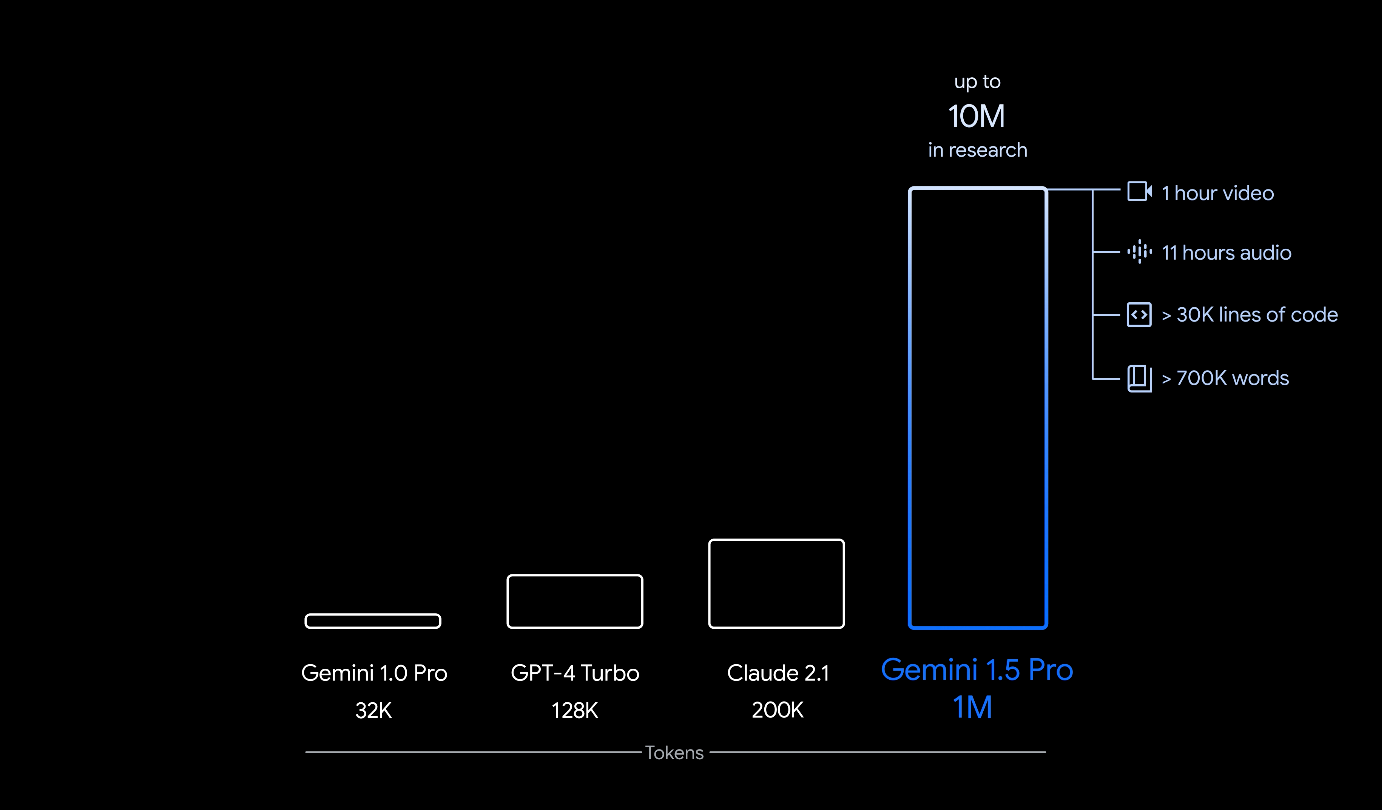
To know more about the context window, check out this video :
How is training a multimodal AI model different?
In the past, traditional model development centered around training for specific use cases.
For instance, developers would train a topic classification model to categorize different topics or a sentiment analysis model to comprehend sentiments. (as depicted in the following image). You can learn further about those specific use cases from this video. To understand the scalability of AI models, here’s a different story.

Multimodal AI models undergo training using diverse datasets encompassing text, images, audio, and more. This extensive training equips them to comprehend and generate various forms of data across a multitude of contexts and tasks.

Multimodal AI can understand information from various sources like text, images, audio, and video. By combining data from different types, these systems get better at understanding complex real-world situations. This helps them make more accurate decisions and interact with people more effectively, similar to human interaction.
Speaking of which, it stands to reason also talk about the next steps as we have some pretty exciting developments in AI robotics, my theory is in the following video :
Looking forward
AI brings lots of challenges for IT professionals to keep up with ever-evolving technological changes in the fast-paced AI space, and there’s always so much to learn! If you enjoy learning and entrepreneurship, you can follow me on my YouTube channel or subscribe to my newsletter, as I’m here to practice my entrepreneurship muscle every week! Stay tuned, and see you in the next one!

 Top 10 AI Startups That Raised Over $100M in 2026
  Why AI Is Becoming an Infrastructure Problem ?
  How Big Tech Is Fighting Over AI Chips Not AI Models
  The $20K Humanoid Robot That Can’t Fold Your Laundry (Yet)
  If I were about to get started with Microsoft Azure in 2026
  If I were about to get started with AWS in 2026